Abstract. We propose the notion of bioability as the subjective correlate to biodiversity. Bioability entails the capacity to maximize the forms and patterns of life within given ecosystems. Cutting across the natural and social sciences, the bioability approach opens up a field for research and intervention, which focuses on the imaginational and aspirational dimensions of terrestrial politics. In the context of increased awareness of climate tipping points, developing bioabilities help advancing experimental practices in ecological conversion.
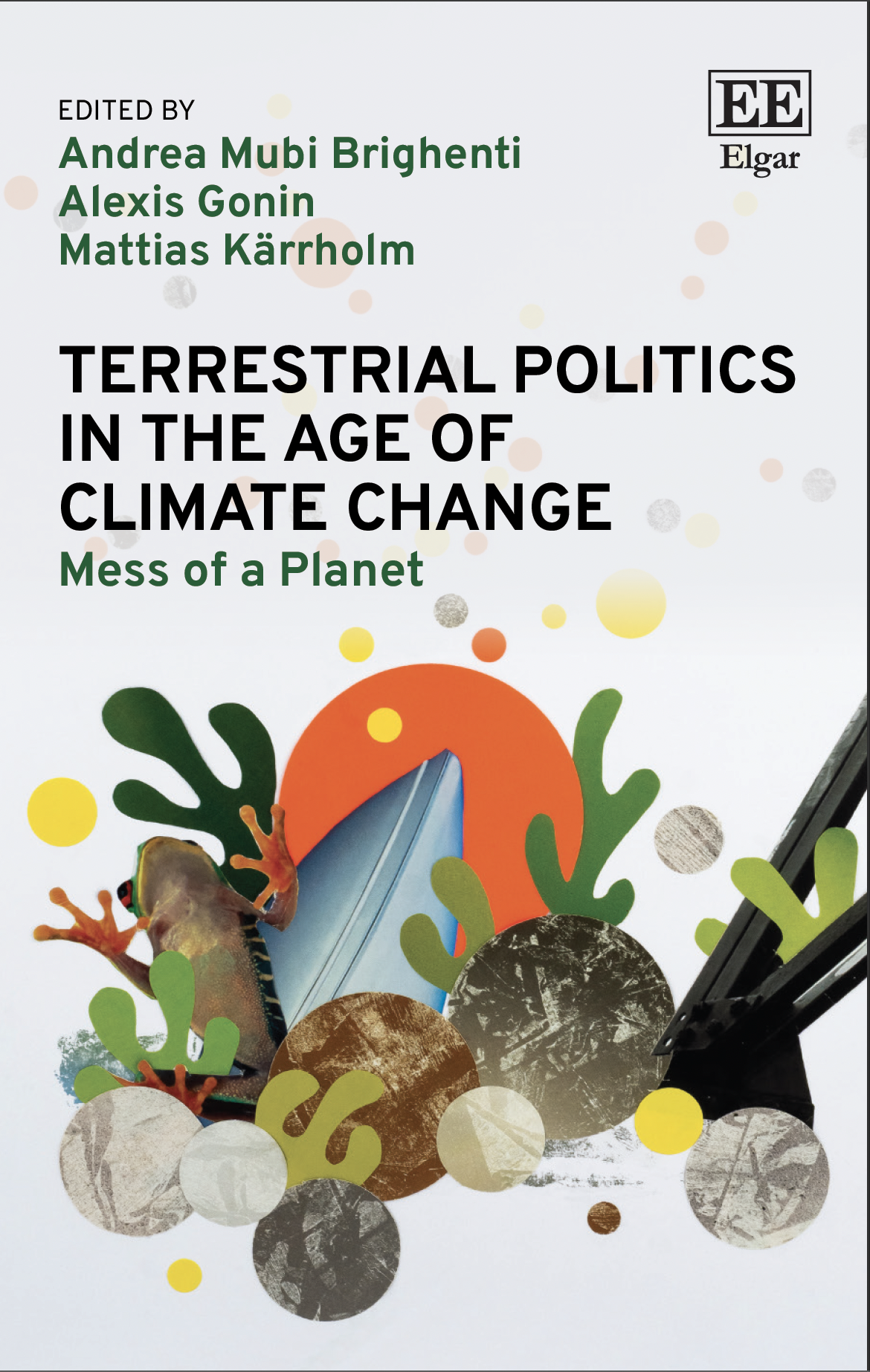
The book seeks to contribute to the debate on the political and societal impact of climate change, with a focus on the new epistemologies that are being developed to recompose and expand ecological thinking. The approach is interdisciplinary across the humanities and social sciences (philosophy, social theory, sociology, anthropology, architecture, political ecology, and human geography). The discussion is theoretically-led and theoretically informed, with rich ethnographic case studies included to provide grounding for analysis. Through a number of “terrestrial stories”, a notion of “terrestrial politics” is developed so as to clarify the role of territories in the current planetary transition. Issues of globalisation, coloniality, ecology and territoriality are here explored through the modes of knowing and experiencing that correspond to them. The book thus enriches the current discussions on climate change and climate politics by emphasising the role of territories in prefiguring an emergent terrestrial politics suitable for conceptualizing an ecological civilization.
Table of Contents
Introduction: Theorizing Terrestrial Politics
Part I. Debating Terrestrialism
1. Luigi Pellizzoni, Mess of a problem. The climate crisis debate as a governmental dispositif
2. Michael J Shapiro, The Ecological Sublime
3. Jeanne Etelain, Towards a Terrestrial Nomos of the Earth: Rethinking Planetary Politics in the Age of Gaia
4. David Blanchon, Sentinel territories
Part II. Terrestrial Stories
5. Andreas Blok and Casper Bruun Jensen, Re-Placing Latour’s Eco-Politics: Cosmopolitics in Cambodian Territories
6. Emile St-Pierre, Living with the unthinkable: System failure, ecology and energy practices in Hokkaido
7. Giuseppina Forte, Raising the Ground, Climbing the Trees: Territorial Irreversibility and Its Contestation in East River Park
8. Konstantinos Avramidis, Taking Care of Refugee Estates, Refugee Estates of Care. Design Scenarios in Nicosia
9. Priyam Tripathy, Planetary Crisis and Uneven Worlds: Air, Heat, and Infrastructures
Endorsements
‘“Thinking globally, acting locally” is not as straightforward as it seems in the face of the climate emergency. While a great variety of globalizing views dominates ecological debate, this book proposes an alternative: terrestrialism “as a sensitivity that does not take the Earth for granted”. Combining innovative conceptual reflections with regionally nuanced analyses, this is an important contribution to ecological scholarship.’
– Peter Wagner, Catalan Institute for Research and Advanced Studies (ICREA) and University of Barcelona, Spain
‘Groaning glaciers, floods, tremors, and extra-human kin jostle alongside cybernetic systems, feral infrastructures, protests, and refugee camps. This diversely populated collection invents a territoriology for sharing the earth equitably. Refusing the Anthropocene’s totalizing conceit, it offers environmental stories grounded in the critical zone. Here, an urgent cosmopolitics reminds us what is at stake for diverse worlds on this badly damaged planet.’
– Hélène Frichot, University of Melbourne, Australia