now out in Etnografia e Ricerca Qualitativa.
The whole unabridged transcript is available upon request.
now out in Etnografia e Ricerca Qualitativa.
The whole unabridged transcript is available upon request.
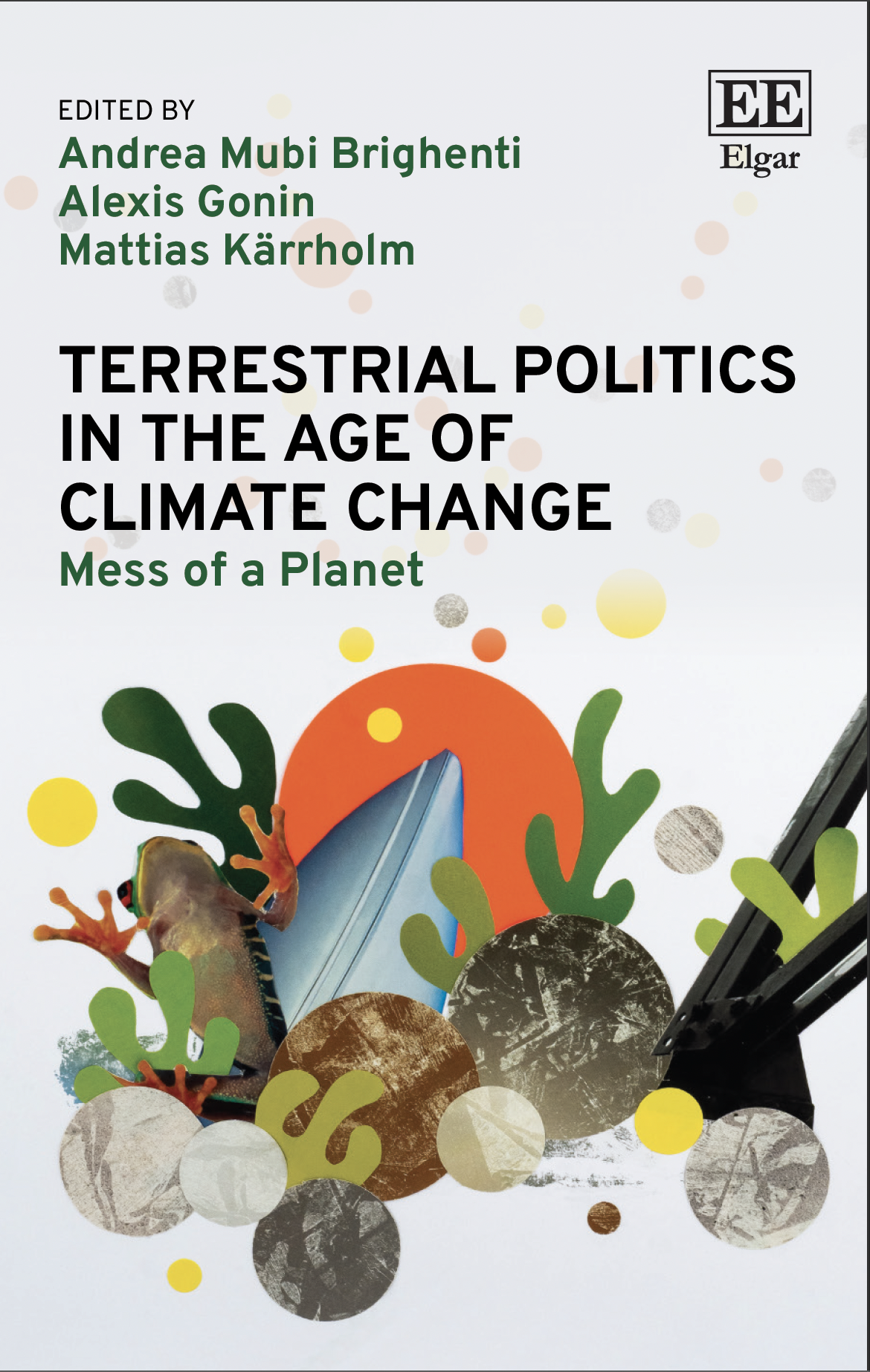
Edited by Andrea Mubi Brighenti, Alexis Gonin & Mattias Kärrholm
Forthcoming with Edward Elgar Publishing
The book seeks to contribute to the debate on the political and societal impact of climate change, with a focus on the new epistemologies that are being developed to recompose and expand ecological thinking. The approach is interdisciplinary across the humanities and social sciences (philosophy, social theory, sociology, anthropology, architecture, political ecology, and human geography). The discussion is theoretically-led and theoretically informed, with rich ethnographic case studies included to provide grounding for analysis. Through a number of “terrestrial stories”, a notion of “terrestrial politics” is developed so as to clarify the role of territories in the current planetary transition. Issues of globalisation, coloniality, ecology and territoriality are here explored through the modes of knowing and experiencing that correspond to them. The book thus enriches the current discussions on climate change and climate politics by emphasising the role of territories in prefiguring an emergent terrestrial politics suitable for conceptualizing an ecological civilization.
Table of Contents
Introduction: Theorizing Terrestrial Politics
Part I. Debating Terrestrialism
1. Luigi Pellizzoni, Mess of a problem. The climate crisis debate as a governmental dispositif
2. Michael J Shapiro, The Ecological Sublime
3. Jeanne Etelain, Towards a Terrestrial Nomos of the Earth: Rethinking Planetary Politics in the Age of Gaia
4. David Blanchon, Sentinel territories
Part II. Terrestrial Stories
5. Andreas Blok and Casper Bruun Jensen, Re-Placing Latour’s Eco-Politics: Cosmopolitics in Cambodian Territories
6. Emile St-Pierre, Living with the unthinkable: System failure, ecology and energy practices in Hokkaido
7. Giuseppina Forte, Raising the Ground, Climbing the Trees:
Territorial Irreversibility and Its Contestation in East River Park
8. Konstantinos Avramidis, Taking Care of Refugee Estates, Refugee Estates of Care. Design Scenarios in Nicosia
9. Priyam Tripathy, Planetary Crisis and Uneven Worlds: Air, Heat, and Infrastructures
Endorsements
‘“Thinking globally, acting locally” is not as straightforward as it seems in the face of the climate emergency. While a great variety of globalizing views dominates ecological debate, this book proposes an alternative: terrestrialism “as a sensitivity that does not take the Earth for granted”. Combining innovative conceptual reflections with regionally nuanced analyses, this is an important contribution to ecological scholarship.’
– Peter Wagner, Catalan Institute for Research and Advanced Studies (ICREA) and University of Barcelona, Spain
‘Groaning glaciers, floods, tremors, and extra-human kin jostle alongside cybernetic systems, feral infrastructures, protests, and refugee camps. This diversely populated collection invents a territoriology for sharing the earth equitably. Refusing the Anthropocene’s totalizing conceit, it offers environmental stories grounded in the critical zone. Here, an urgent cosmopolitics reminds us what is at stake for diverse worlds on this badly damaged planet.’
– Hélène Frichot, University of Melbourne, Australia


(with Tali Hatuka)

Out on August 18, 2025 – See : https://www.routledge.com/A-New-Index-for-Public-Space-After-Distancing/Hatuka-Brighenti/p/book/9781032555836
With four generous endorsements from:
“This erudite and provocative book melds social and political theory with design thinking to produce a new set of terms to understand both the nature and the phenomenology of publicness. Inspired by the challenges of physical distancing that accompanied the global pandemic, the authors show the durability of the public realm while offering new ways to interpret and produce a range of disordered, agonistic, and spatially-situated interactions that will continue to make public spaces the lifeblood of cities.”
Diane E. Davis, Charles Dyer Norton Professor of Regional Planning and Urbanism, Harvard Graduate School of Design
*
“How can we talk about public space and make sense of its continuous mutations in contemporary cities? As the authors suggest, we need to explore patterns of experience and affect along with efforts to conceptualize sociospatial crises. This book is an inventive and highly successful experiment in analyzing publicness that offers to city dwellers and planners alike an index of terms to be used in thinking about city life as a multifarious set of realities and possibilities.”
Stavros Stavrides, Professor of Architectural Design and Theory, School of Architecture, National Technical University of Athens
*
“Triggered by the contemporary challenges and appreciation of the post-pandemic future of urban space the authors continue the quest to understand and assess public space. Through a new index they introduce us to a series of fresh and inspiring methods and prompts that traverse disciplinary boundaries and help explore the experiential and phenomenological dimensions of public space. The book is a welcome addition that introduces researchers, teachers, and students in the built environment and social science disciplines to innovative ways of examining the future of public space and eventually to show new ways to “read” the city.”
Vikas Mehta, Fruth/Gemini Chair, Ohio Eminent Scholar of Urban/Environmental Design, and Professor of Urban Design, University of Cincinnati
*
“This is a playful book on how public space negotiates distance and propinquity amongst human and nonhuman bodies. It is a truly exciting cornucopia of affects, memories and desires that crisscross one another like a boardgame. But like most good boardgames, here too there is wisdom, depth and astute observation of all the things that compose ourselves and our lives. The authors have managed the impossible: to create an intensely visual, lyrical, ludic net of possibilities about our post-Covid world in way that is both celebratory and cautionary, visionary and sobering. In many ways, through its innovative form, its collaborative process of writing, and its ground-breaking content, this book opens up an entirely new way of being in public. This is a fundamentally beautiful and useful book.”
Andreas Philippopoulos-Mihalopoulos, Professor of Law & Theory, University of Westminster, UK; Artist and Fiction Author
Co-edited with Alberto Brodesco & Carlo Brentari
Chek it out at : https://www.losquaderno.net/?p=2409
A Keynote Speech at Planning Studies Academic Year Opening, University of Florence, 23 September 2024


Terrestrial territories: From the Globe to Gaia, a new ground for territory
by Alexis Gonin, Jeanne Etelain, Patrice Maniglier and Andrea Mubi Brighenti
OUT NOW in Dialogues in Human Geography – https://journals.sagepub.com/doi/abs/10.1177/20438206241240213
Abstract. Territory is a central tool for analysing the politics, primarily between nation-states, of the division of a world based on the figure of the Globe. However, with the Anthropocene, the ground of territories has somehow changed, shifting from ‘the Globe’ of the globalisation age, to the Anthropocene, where Gaia, or the earth-system, ‘irrupts’ onto the political scene. Yet, both sovereign territories and critical approaches to territoriality, despite revealing the role of non-human actors in territorial interactions, fail to take into account the issue of the habitability of the Earth. This article advances the notion of ‘terrestrial territories’ as a new descriptive and analytical tool for a Gaia-politics intended to transcend traditional geopolitics by taking into account the dynamics of the planet. Resulting from the original intersection between critical territory studies and the late work of Bruno Latour, it introduces terrestrial territories as an original and much-needed notion that could help to describe new coalitions of actors along new lines of divisions and conflicts based on the logic of Gaia. Beyond the famous but inefficient ‘think global, act local’ scheme, the notion of terrestrial territory tries to reconcile the apparent hyperglobal nature of the planetary and the obviously local nature of action.
…
Tu es seul le matin va venir
Les laitiers font tinter leurs bidons dans les rues
La nuit s’eloigne ainsi qu’une belle Métive
C’est Ferdine la fausse ou Léa 1′attentive
Et tu bois cet alcool brulant comme ta vie
Ta vie que tu bois comme une eau-de-vie
Tu marches vers Auteuil tu veux aller chez toi à pied
Dormir parmi tes fetiches d’Océanie et de Guinée
ils sont des Christ d’une autre forme et d’une autre croyance
Ce sont les Christ inférieurs des obscures ésperances
Adieu Adieu
Soleil cou coupé
Apollinaire, Alcools (1913)
An online seminar to be given on Thursday 07 December 2023 Time: 12:30-13:30 (UTC+00:00 – Dublin, Edinburgh, Lisbon, London.)
Abstract:
In this lecture, Professor Brighenti seeks to introduce territoriology as a research approach and a sensitivity that can be applied to the study of public space. He explores the intersection between social theory, ethnography, human geography and design as helpful to study territorial productions in the making. Each territory is shaped by imaginational and figurational forces of social life as they get incorporated into a set of materials. Starting from this assumption, he would like to illustrate a few cases and possible applications in the field of urban studies.
To get the Zoom link, pls contact ARCHI Research <ARCHI-research@cardiff.ac.uk>
“It is at the frontiers that the companions desert us—that the girl returns to the old country
that we are alone.”
Archibald MacLeish, “Definition of the Frontiers”. From Collected Poems 1917-1982.
Il 3 marzo 2023 h.18:30 a TN faremo una piccola discussione con Emanuela Schir, Roberta Re e Umberto Anesi intorno a margini urbani, aree interne, paesaggio & co.
https://www.tsm.tn.it/attivita/paesi-perduti-dai-territori-alla-mostra-e-viceversa

I’ll be discussing the new Visibility collection with graduate students in Planning.

Thankful for Gordon Waitt’s review of Animated lands, recently published in Social & Cultural Geography, www.doi.org/10.1080/14649365.2022.2077571
Happy to be included witha short feature in Coabitare l’isola. Spazio pubblico e cura dei luoghi, Edited by Giorgio Azzoni and Pasquale Campanella (Mimesis, 2022).

Just arrived.


« La fulguration est le tremblement de qui désire ou rêve la totalité impossible, ou à venir ; la durée exhorte celui qui tâche à la vivre, quand les histoires conjointes des peuples en dessinent l’aube. »
Edouard Glissant
This year’s edition is themed around nomads, neo-nomads, nomadizing etc.
Hosted exciting lectures by Les Roberts, Tali Hatuka, Alice Brombin and Andrea Pase.
Among other things, I’m still pondering about the work of the great land artist Robert Smithson – https://www.capacitedaffect.net/?p=1490
…

Animated Lands is a book that encompasses different case studies, but they are all strongly integrated into a single research programme. We got to know each other over a decade ago, and soon started collaborating around our shared interest for understanding social-spatial phenomena. We have since been organising seminars, attending conferences, lecturing together, and paying research visits to each other to bring the project to completion. We have not started from a single theory, a paradigm, or anything of that sort, but mostly from passion, as well as from an expanding curiosity for the topics we were stumbling upon along the way. A number of themes started resonating, took speed, and at some point we felt the book was just ripe.
Over time, we increasingly realised that, in urban and architectural studies, territory – or if you want, more simply, land – was an underrated notion, yet one with a lot of potential. So we picked up an old word, ‘territoriology,’ and tried to use it in a new sense. Seeking to retrieve and revive a science that was born under positivistic auspices, and dealt with politically charged phenomena, we thought that we also needed to warn the reader against the possible regressive uses of these notions, and how easy it is to get trapped into a certain worldview. That’s why we have striven to promote a different take on the life of territories – what they are about, what they accomplish. To counter gloomy and regressive views, we sought to foreground aspects of vitality, spontaneity and unpredictability that are ever-present in territory-making.
We do not have a favourite book in the absolute sense, but there are some books to which it is always a pleasure to return to. One is, inevitably, Walter Benjamin’s Arcades Project. It’s a book that’s impossible to read from start to finish, simply because it is itself unfinished, and made only of fragments. Together with all the other urban essays by Benjamin (including masterpieces such as Berlin Childhood around 1900), returning to Arcades never fails to provide fresh inspiration, intuitions and emotions. It’s more than cultural theory and urban history – to our minds it is actually sustained, fully accomplished territoriology.
The list could be quite long! We are constantly looking for inspiration across the domains of literature, philosophy, the humanities, as well as social and life sciences. But for one, Bruce Chatwin’s short-prose collections What Am I Doing Here? and Anatomy of Restlessness are colourful, charming explorations into how territorial life generates its own inherent deterritorialistions. Chatwin’s forays into what he called ‘the nomadic alternative’ encompass, stories, encounters, documentations, self-analyses… ‘Why – he famously asked – do I become restless after a month in a single place, unbearable after two? (I am, I admit, a bad case.)’ Questions like this one are the sort of powerful, provocative questions we like to engage with.
…more territoriology! Animated Lands is, above all, an invitation. Rather than launches and presentations, we envisage to put the book directly to use in practical workshops, where participants could experiment their own way into inquiring territories. Most rewarding for us would be to learn that some other scholars and readers are similarly using our book this way, as a possible blueprint for carrying out further fresh research into the many facets of social-spatial life.


